Stargate UAE Broke Ground: What the $30B Abu Dhabi AI Campus Means for Gulf Professionals and Jobs
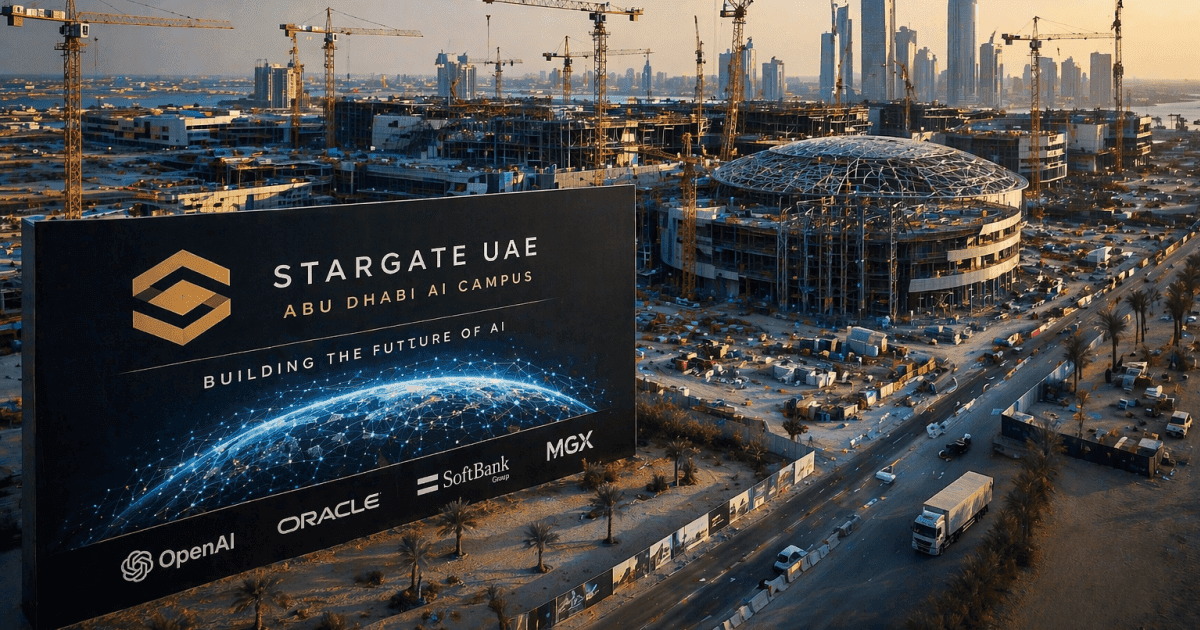
On March 20, 2026, construction crews broke ground at Masdar City on the most consequential piece of technology infrastructure the Middle East has ever seen. The UAE–U.S. AI Campus anchored by Stargate UAE is a $30 billion, 10-square-mile AI compute complex that will eventually consume 5 gigawatts of power. To put that in perspective: the entire country of Denmark runs on roughly 4 gigawatts. This is not a data center upgrade. It is a deliberate national bet that AI infrastructure will be to the 2030s what oil fields were to the 1970s. For professionals working in the Gulf today, the implications are immediate, concrete, and career-altering. This article breaks down exactly what Stargate UAE is, why Abu Dhabi won the deal, what jobs and industries it will reshape first, and how you can position yourself before the window narrows.
What Is Stargate UAE? A Plain-English Breakdown
The numbers matter here, so let us be precise. Stargate UAE is a 1-gigawatt AI compute cluster that forms the core of the larger UAE–U.S. AI Campus, which will ultimately reach 5 gigawatts of total capacity across its full footprint. The first 200-megawatt phase is on schedule to go live in 2026, with the full 1-gigawatt Stargate cluster expanding through 2027.
The ownership structure is sovereign by design. G42, the Abu Dhabi-based AI and cloud company chaired by Sheikh Tahnoon bin Zayed Al Nahyan, holds a 60% stake and is developing the physical infrastructure through its subsidiary Khazna Data Centers. OpenAI holds a 20% stake and contributes AI models, training methodology, and research capability including access to future model generations not yet released publicly. Oracle co-operates the facility alongside OpenAI. NVIDIA supplies the hardware backbone: Grace Blackwell GB300 systems, its most advanced data center AI chips, combining 72 Blackwell Ultra B300 chips with 36 Grace CPUs per node. Cisco handles zero-trust security and AI-ready networking. SoftBank rounds out the consortium as a strategic financial backer.
The campus will be powered by a mix of nuclear, solar, and natural gas to manage both the carbon footprint and the sheer load a practical reality given that no single renewable source in the region can reliably sustain 5 gigawatts of round-the-clock compute demand.
Reality check: G42 is already in advanced talks to bring Google, Microsoft, AMD, Cerebras Systems, and Qualcomm into the broader campus as additional partners, per Semafor reporting from October 2025. The campus is designed for expansion, not a fixed endpoint.
For context on scale, the US Stargate campus in Abilene, Texas is targeting approximately 1.2 gigawatts. When fully built, the UAE campus would be more than four times that size, making it potentially the largest AI data center complex on the planet.
Why the UAE? The Strategic Logic Behind the World's Largest AI Campus
Three forces converged to make the UAE the obvious choice for the first international Stargate deployment.
The geography argument is real. The UAE sits within a 2,000-mile radius of roughly 3 billion people covering the entirety of South Asia, East Africa, the Middle East, and Central Asia. For a company like OpenAI building the infrastructure for low-latency AI inference at regional scale, that geography is not a talking point, it is a technical requirement. Hosting in Frankfurt or Singapore creates latency problems for half the users this campus is designed to serve.
G42's geopolitical pivot was decisive. Between 2022 and 2024, G42 made a series of high-visibility moves to distance itself from Chinese technology partnerships including Huawei specifically to meet US government requirements for receiving advanced semiconductor exports. That process was not cosmetic. It involved real structural changes to G42's shareholder base and technology supply chain. The payoff was access to NVIDIA's most advanced chips at scale, which no company in the region had secured before. Without those chips, Stargate UAE does not exist.
The deal sits inside a larger US-UAE strategic framework. The US-UAE AI Acceleration Partnership announced during President Trump's visit to the UAE is the formal diplomatic container for Stargate UAE. The UAE also committed to investing $1.4 trillion in the United States over the coming decade. This is not a commercial tech deal. It is a mutual sovereignty agreement dressed in data center language: the UAE gets frontier AI access and sovereign compute; the US gets a trusted Middle Eastern partner on the "US AI rails" rather than Chinese alternatives.
For Gulf professionals, the implication is direct. The UAE is not positioning itself as a neutral host for foreign tech companies. It is asserting itself as an AI superpower with sovereign infrastructure, exclusive model access, and a deliberate alignment with the US AI ecosystem. That changes the nature of the jobs, the regulations, and the opportunities that follow.
What This Means for Gulf Professionals Right Now
The Jobs Being Created
The talent requirement for a project of this scale is not primarily about AI researchers. The majority of near-term hiring falls into three categories:
Infrastructure and operations roles are the most immediate. Khazna Data Centers is already recruiting data center operations engineers, electrical and mechanical specialists familiar with hyperscale cooling systems, network infrastructure engineers (Cisco's zero-trust architecture will require specialist deployment teams), and physical security and compliance roles. NVIDIA GB300 systems require specialist technicians familiarity with GPU cluster deployment at scale is a specific, scarce skill that commands a premium.
AI platform and model operations roles will accelerate as Phase 1 comes online in late 2026. OpenAI and Oracle will need MLOps engineers, model fine-tuning specialists, inference optimization engineers, and API platform engineers capable of handling regional enterprise deployments. These are not entry-level roles. They typically require 3 to 7 years of hands-on experience with large-scale model deployment or cloud infrastructure.
Sector application roles are where most Gulf professionals will find their entry point. The campus's stated priority sectors are healthcare, energy, finance, transportation, and government. A finance professional at a UAE bank who understands both CBUAE regulatory requirements and can evaluate or deploy AI models in fraud detection or credit risk is more valuable now than a pure AI engineer who has never worked in a regulated Gulf industry. Sector expertise plus AI literacy is the combination that will dominate hiring in 2026 and 2027.
G42 has also launched a scholarship program sending 200 Emirati students annually to leading technology universities in the US and UK, specifically to build the long-term Stargate talent pipeline. [UNVERIFIED human must check current cohort size and university partners before publishing.]
Industries That Will Be Transformed First
Healthcare is the headline sector, and the infrastructure justifies it. Large-scale diagnostic AI radiology, genomic sequencing, drug discovery is computationally intensive enough that it genuinely requires the kind of sovereign, low-latency compute that Stargate UAE provides. Shipping patient genomic data to a US data center creates PDPL compliance problems; running the same workload inside Masdar City does not.
Finance will move faster because the ROI is already proven. UAE banks and investment firms are running AI for fraud detection and credit scoring today on general cloud infrastructure. When Stargate UAE is live, the compute access improves, the data sovereignty argument for UAE-sensitive financial data gets cleaner, and the latency for real-time risk models drops. The procurement cycle at institutions like ADNOC, Mubadala, and the major UAE commercial banks will accelerate, not slow down.
Energy and predictive maintenance is the quietest but most commercially significant application. The UAE's oil and gas infrastructure, managed largely through ADNOC, generates enormous sensor data volumes that are expensive to model in real time. Sovereign AI compute at scale changes the economics of predictive maintenance on physical assets worth billions of dirhams.
How to Position Yourself for Stargate UAE Opportunities
The mistake most professionals make is treating Stargate UAE as a future opportunity to prepare for later. The hiring pipeline is already building. Here is a practical, tiered view of what actually moves the needle.
For technical professionals:
- NVIDIA's GB300 / Grace Blackwell architecture is the hardware standard for Stargate. Familiarity with CUDA, NCCL, and distributed GPU training is increasingly differentiated. NVIDIA's certification ecosystem (NVIDIA Deep Learning Institute) now includes courses specific to this architecture.
- Oracle Cloud Infrastructure (OCI) certifications are directly relevant given Oracle's operating role in Stargate UAE. OCI AI Foundations and OCI Generative AI Professional are the specific tracks to prioritize.
- MBZUAI Mohamed bin Zayed University of Artificial Intelligence in Abu Dhabi is the most direct local academic pathway to Stargate-adjacent roles. Their MSc and PhD programs have direct research partnerships with G42 and OpenAI. If you are considering a master's program and want to be inside the Gulf AI ecosystem, MBZUAI is the clearest signal you can send on a CV.
For business and sector professionals:
- Document your AI deployment experience now, even if it is basic. Running a ChatGPT Enterprise pilot at your company and writing up the outcomes is more valuable in a Gulf hiring context than completing a generic online AI course. Employers in this market respect demonstrated judgment over completed certifications.
- Familiarize yourself with UAE data governance. The UAE's Personal Data Protection Law, DIFC data protection regulations, and ADGM's equivalent framework are the compliance landscape that every AI deployment in the country will have to navigate. Understanding these at a working level not a legal expert level makes you significantly more useful in cross-functional AI project teams.
- Target companies in the G42 portfolio and its enterprise customer base. G42's subsidiaries Khazna, Bayanat, Inception AI are expanding rapidly and tend to hire professionals with Gulf-specific context over international candidates without regional experience.
For startup founders and entrepreneurs: Stargate UAE includes plans for a science park adjacent to the compute campus, intended to support startups with subsidized compute access. Formal application channels had not been publicly announced as of March 2026. [UNVERIFIED human must check G42 and UAE Ministry of AI portals for current startup program details before publishing.] The parallel to watch is how the US Stargate program has structured enterprise access agreements similar frameworks are likely in the UAE deployment.
Reality check: Access to subsidized compute does not automatically translate to a viable business. The bottleneck for most Gulf AI startups is not compute it is proprietary data, regulatory clearance to use that data, and enterprise customer relationships. Stargate UAE addresses the first constraint; the other two remain the harder problems.
The Bigger Picture: UAE's Race to Own Global AI Infrastructure
The numbers that do not get enough attention are the ones about scope. The UAE–U.S. AI Campus is not just Stargate UAE's 1 gigawatt. The total campus is planned for 5 gigawatts across its full buildout. At that scale, Abu Dhabi would house more dedicated AI compute than most entire countries. Masdar City becomes, functionally, the compute capital of a 3-billion-person catchment market.
OpenAI has confirmed that the UAE is the first country in the world to enable ChatGPT nationwide under the OpenAI for Countries framework. It is important to be precise about what this means. It does not mean every resident gets a free personal ChatGPT Plus subscription that claim circulated widely in mid-2025 and was a misreading of the announcement. What it does mean is that OpenAI's technology will be embedded at the national infrastructure level: in government services, healthcare systems, and educational institutions. The individual consumer experience is secondary to the institutional integration. Enterprise data under this arrangement benefits from UAE data residency, meaning sensitive information processed by OpenAI models stays within UAE borders and under UAE regulatory jurisdiction.
The geopolitical framing from OpenAI CEO Sam Altman has been explicit: the goal is to bring as many countries as possible onto "the US AI rails." The UAE, as the first international Stargate deployment, is both a technical achievement and a diplomatic signal. Saudi Arabia, India, Japan, and several other countries are reportedly in active conversations for similar OpenAI for Countries arrangements. The UAE moved first and locked in infrastructure advantages that will compound for years.
For Gulf professionals, the practical implication is this: the UAE is no longer competing to attract international AI companies. It is building the infrastructure those companies will depend on to serve the region. That is a fundamentally different power position, and it changes what skills, experience, and employer choices will be valuable over the next five years.
Frequently Asked Questions
When will Stargate UAE actually be operational? The first 200-megawatt phase of the 1-gigawatt Stargate UAE cluster is on schedule for 2026, according to G42's Khazna Data Centers, which confirmed construction is well advanced as of late 2025. The full 1-gigawatt Stargate cluster will expand through 2027. The broader 5-gigawatt UAE–U.S. AI Campus, of which Stargate UAE is one component, will develop over subsequent phases with timelines dependent on demand.
Can companies outside the UAE access Stargate UAE compute? The project is designed to serve a regional catchment the 2,000-mile radius covers South Asia, East Africa, Central Asia, and the wider Middle East. International access for enterprise customers is part of the commercial model, though specific pricing and access agreements for non-UAE entities had not been publicly announced as of March 2026. [UNVERIFIED human must check G42 and Oracle enterprise announcements before publishing.] The data residency question is the key variable: data processed on Stargate UAE infrastructure stays inside the UAE, which is either a feature or a constraint depending on your jurisdiction.
How does Stargate UAE compare to the US Stargate project in Texas? The US Stargate campus in Abilene, Texas, is targeting approximately 1.2 gigawatts. Stargate UAE's 1-gigawatt cluster, within a 5-gigawatt campus, would when fully built be substantially larger. The two projects are parallel deployments of OpenAI's infrastructure platform, not competing alternatives. The Texas campus primarily serves North American workloads; the Abu Dhabi campus is explicitly positioned to serve the MENA, South Asia, and East Africa markets. The governance model also differs: Stargate UAE has G42 holding 60%, making it a sovereign-majority asset from day one.
What does this mean for Saudi Arabia and the wider GCC? Saudi Arabia is watching this development closely and has its own national AI ambitions through SDAIA and the Saudi Vision 2030 framework. The UAE's first-mover advantage in Stargate infrastructure does not preclude Saudi participation OpenAI has signaled interest in 10 OpenAI for Countries partnerships globally but it does mean that any Saudi sovereign AI infrastructure will be built in the context of an already-operational UAE hub next door. For GCC professionals, this creates opportunity: the region as a whole is becoming the most AI-infrastructure-dense zone outside the US and China, and skills that work in Abu Dhabi are portable to Riyadh, Doha, and beyond.
What happens to data privacy under Stargate UAE? This is the question Gulf enterprise buyers will ask before signing any agreement. The short answer is that Stargate UAE is designed as sovereign infrastructure data processed on it stays under UAE jurisdiction, not US jurisdiction. OpenAI has already launched UAE data residency options for enterprise customers, with configurable retention policies and a Data Processing Addendum ensuring enterprise API data is not used to train OpenAI models by default. For companies navigating UAE PDPL compliance or DIFC data protection requirements, this architecture is more workable than relying on US-hosted OpenAI endpoints. For Saudi companies subject to PDPL under SDAIA, the cross-border question requires separate legal analysis before any Stargate UAE workload can be considered compliant. [UNVERIFIED human must verify current SDAIA guidance on GCC cross-border data flows before publishing.
The ground has been broken. The construction crews are on site. The first 200 megawatts of Stargate UAE will be live before most professionals in the Gulf have had time to meaningfully respond to what this means for their careers. The window to position whether as a technical specialist, a sector-fluent AI practitioner, or a startup founder targeting the science park is open now, not in 2027. The professionals who treat March 2026 as their signal to act will have a two-year head start on everyone who waits to see what happens next.