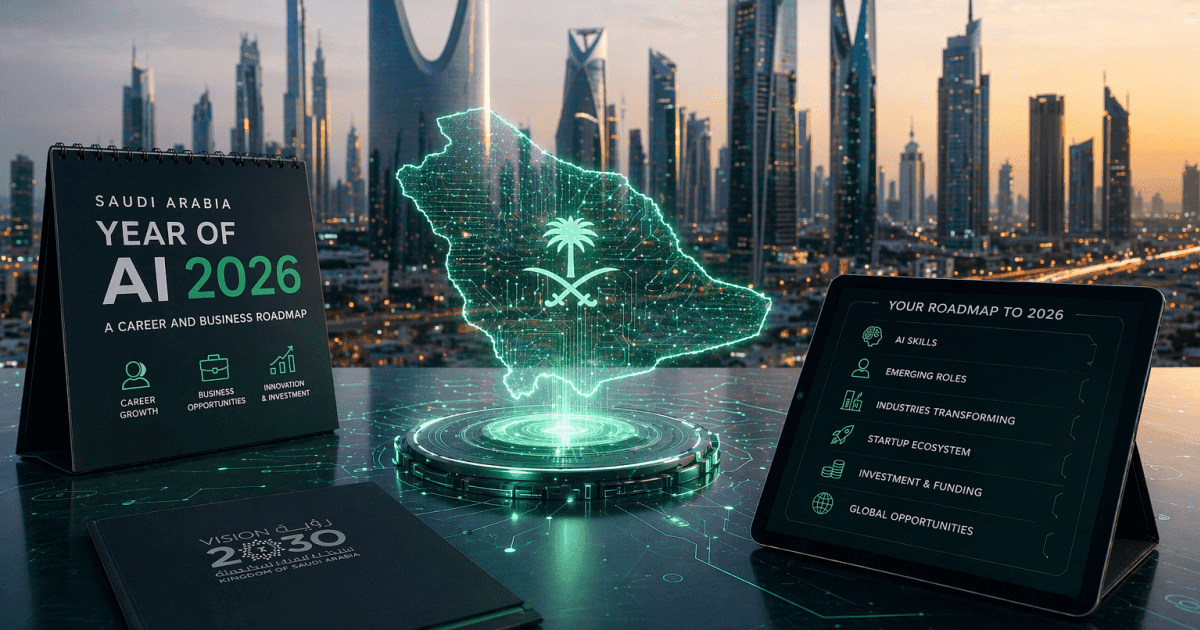
On March 10, 2026, the Saudi Cabinet formally approved a $9.1 billion investment pipeline, transitioning the Kingdom's artificial intelligence ambitions from strategic whitepapers into active enterprise procurement. For professionals and founders operating in Riyadh or entering the GCC market, navigating the Saudi Arabia Year of AI 2026 career landscape requires moving entirely beyond the hype. This mandate actively triggers new regulatory frameworks, fast-tracks government vendor approvals, and creates an immediate, highly localized demand for specialized technical roles.
What the 'Year of AI' Actually Means for KSA Professionals
TL;DR: The Year of AI is a legally binding Cabinet mandate that locks out non-compliant vendors from government contracts while prioritizing AI-certified companies for immediate funding and procurement.
The Year of AI in Saudi Arabia is a formal, legally binding policy designation enacted by the Saudi Cabinet on March 10, 2026, mandating immediate procurement preferences and expanded funding access for AI-integrated companies across all government ministries. It is not a symbolic public relations campaign; it is a rigid regulatory trigger that dictates exactly how the Kingdom evaluates vendors, distributes capital, and hires technical talent.
For companies operating inside the Kingdom, this designation acts as an absolute procurement gate. It legally instructs government entities to prioritize AI-enabled solutions, actively locking out legacy software vendors from upcoming RFPs. Crucially, it opens expedited pathways to capital managed directly by SDAIA. This capital allocation is strictly governed by six strategic pillars:
- Ambition
- Competencies
- Policies
- Investment
- Innovation
- Ecosystem
If a vendor or project does not map directly to one of these pillars, it will struggle to secure government funding.
Reality check: While the funding pools are massive, navigating the approval matrix requires demonstrating strict local compliance. Foreign startups cannot simply deploy existing models into KSA without establishing local, secure server infrastructure that satisfies Saudi data residency laws.
This structural pivot dictates entirely different survival strategies based on your market position. For founders, the priority shifts immediately from pitching general capabilities toward proving strict compliance to secure enterprise procurement fast-tracks, while for professionals, the mandate draws a hard line between generalists facing wage stagnation and technical specialists who can actually deploy these newly required systems.
The Numbers Driving Saudi Arabia's AI Ambition
The mandate's severity is best understood by tracking the capital allocation, where government spending on AI has surged 56.25% in 2024 compared to the previous year. This capital velocity has already secured $9.1 billion across 70 distinct investment deals. Rather than funding isolated research, this pipeline directly subsidizes the 664+ companies currently operating within Saudi Arabia's data and artificial intelligence sector. For a B2B founder or an enterprise sales director, this is not abstract market growth; this represents a massive, highly capitalized buyer base actively searching for compliant vendor solutions to fulfill their own government mandates.
Software requires physical compute power, and the state is building it at an unprecedented scale. In January 2026, ground broke in Riyadh on the Hexagon Data Center, constructed across a 30 million square foot site. With a total planned capacity of 480MW, it is engineered to be the world's largest government data facility. The first 120MW phase targets operational status by late 2026, housing the newly launched Shaheen III supercomputer. This hardware backbone specifically powers the National Data Lake, an architecture that already integrates complex information from over 430 government systems.
Reality check: The sheer scale of this infrastructure demands systems architects who can handle massive data ingestion. Professionals without proven enterprise-grade deployment experience will find themselves locked out of these mega-projects.
These investments have radically altered the Kingdom's global competitive posture. The 2025 Global AI Index by Tortoise Intelligence saw Saudi Arabia jump 17 places to rank 14th globally, surpassing the UAE to claim first in the Arab world. Furthermore, the Center for Data Innovation’s Public Sector AI Adoption Index 2026 places Saudi Arabia at #1 globally with a score of 66/100, decisively beating Singapore and India (tied at 58). The Kingdom leads all five dimensions of this index: enthusiasm (79), empowerment (69), education (68), embedding (60), and enabling (55). Cementing this regulatory authority, the nation ranks 3rd globally in the OECD AI Policy Observatory and sits first in the Arab world for advanced AI model development according to Stanford indicators. For professionals evaluating market entry, these metrics confirm that KSA is no longer an emerging tech hub—it is the dominant operational baseline for the region.
Which Sectors Are Securing the Heaviest AI Investment
Generalist AI applications hold little value in the current Saudi market. Sovereign wealth and ministry budgets are bypassing horizontal software in favor of vertical, highly regulated enterprise deployments. To secure contracts or high-tier roles, professionals must align their expertise with one of these four capitalized sectors:
- Energy and Industrial Infrastructure: Saudi Aramco reported a Technology Realised Value (TRV) of $5.3 billion from AI in its 2025 results alone, pushing its cumulative TRV to $11.3 billion since 2023. To support this physical scale, Aramco Digital launched the Kingdom's first nationwide industrial communications network in the 450MHz band, covering 50+ industrial zones to support industrial IoT and edge AI. The anchor for this computational power is METABRAIN, an internal 250-billion-parameter LLM custom-built for complex oilfield optimization.Target Opportunity: This aggressive infrastructure deployment creates an immediate, high-paying market for edge computing specialists and industrial IoT architects.
- Target Opportunity: This aggressive infrastructure deployment creates an immediate, high-paying market for edge computing specialists and industrial IoT architects.
- Financial Services and Fintech: SAMA (the Saudi Central Bank) has established strict AI guidelines to govern the rapid fintech expansion heavily concentrated in Riyadh's financial district. These mandates require exhaustive model explainability, rigorous bias testing, and concrete model risk management frameworks before any AI-driven financial product can legally launch.Target Opportunity: This zero-tolerance regulatory environment makes AI risk managers and algorithmic governance analysts highly sought after by local and regional banking institutions.
- Target Opportunity: This zero-tolerance regulatory environment makes AI risk managers and algorithmic governance analysts highly sought after by local and regional banking institutions.
- Healthcare and Smart Cities: Applied medical AI is heavily anchored by NEOM, where active programs deploy smart diagnostics and remote patient monitoring across the linear city model. Governance for these sensitive biomedical applications is tightly overseen by the UNESCO-backed International Centre for AI Research and Ethics, which is purposefully headquartered in Riyadh to serve as a regional governance anchor.Target Opportunity: Companies operating in this space desperately need biometric data engineers and medical AI product managers fluent in complex data compliance standards.
- Target Opportunity: Companies operating in this space desperately need biometric data engineers and medical AI product managers fluent in complex data compliance standards.
- Government and Public Sector: SDAIA's newly live AI procurement system fundamentally dictates how all Saudi ministries purchase technology. Through the SAMAI 2 initiative, launched in partnership with 11 government ministries, the explicit mandate is embedding AI into existing public sector workflows rather than building new, bloated administrative layers. This operational push follows the massive SAMAI 1 baseline program, which successfully trained 1.1 million citizens with accredited AI certifications, boasting a 52% female participation rate.Target Opportunity: This structural pivot means technical integration consultants who can bridge legacy systems with new AI mandates hold the keys to unlocking lucrative public sector contracts.
- Target Opportunity: This structural pivot means technical integration consultants who can bridge legacy systems with new AI mandates hold the keys to unlocking lucrative public sector contracts.
Top AI Career Opportunities and SAR Salary Benchmarks.
The rapid scaling of Vision 2030 tech initiatives has triggered a severe supply-demand imbalance in the domestic labor market, fundamentally inflating technical compensation for specialized talent. Based on verified 2026 market data cross-referenced from regional hiring platforms, these are the top ten artificial intelligence roles currently driving recruitment in the Kingdom, complete with localized monthly salary benchmarks:
- AI Product Manager: SAR 20,000–42,000/month
- ML Engineer: SAR 15,000–40,000/month (scaling rapidly from entry-level to senior technical lead positions)
- NLP Engineer (Arabic language AI): SAR 18,000–38,000/month
- AI Ethics / Governance Officer: SAR 18,000–35,000/month (an emerging necessity driven by mandatory PDPL and UNESCO ICAIRE compliance)
- Data Scientist: SAR 15,000–35,000/month
- Robotics / Edge AI Engineer: SAR 16,000–34,000/month (heavily concentrated around NEOM medical infrastructure and industrial IoT)
- Computer Vision Engineer: SAR 16,000–32,000/month
- AI Engineer (Riyadh specifically): SAR 14,333–24,750/month for mid-market roles, with cleared top earners commanding SAR 30,000+
- Data Engineer (AI pipelines): SAR 14,000–28,000/month
- AI Consultant: SAR 13,000–23,000/month (averaging SAR 158,845–277,352 annually)
Understanding these ranges requires looking past the base numbers to the three specific market frictions driving salary variance. First, the Saudization premium remains exceptionally high; Saudi nationals holding deep technical expertise routinely capture the upper quartiles of these pay bands to satisfy strict localization hiring quotas within government contracts. Second, your chosen sector dictates your ceiling. An AI Product Manager deploying predictive risk models in fintech or energy will reliably out-earn their equivalent in retail by a wide margin. Finally, security clearance requirements for government projects create a closed, highly lucrative ecosystem. For example, the massive premium paid for Arabic NLP Engineers is a direct consequence of the absolute scarcity of talent that is both legally cleared and technically capable of advancing SDAIA's sovereign Arabic language models.
To bridge this profound talent deficit, Microsoft's EMEA division committed in February 2026 to skilling 3 million people in Saudi Arabia in AI by 2030. For professionals currently feeling locked out of these high-tier salary bands, this represents an immediate, highly subsidized certification pathway that is directly recognized by local enterprise hiring managers.
What Businesses Must Do to Secure AI Procurement Contracts
The Year of AI designation fundamentally rewrites the rules of B2B sales inside the Kingdom by establishing explicit procurement preferences. Government agencies are now legally mandated to prioritize AI-enabled vendors over traditional software providers. To qualify for this preferred status, businesses must secure SDAIA AI Certification. This requires demonstrating that your deployment aligns precisely with the official Year of AI guidelines issued by SDAIA immediately following the March 10 Cabinet approval. This framework serves as the operational filter separating genuine artificial intelligence infrastructure from legacy tools wrapped in marketing terminology.
Securing that certification requires navigating the Saudi PDPL (Personal Data Protection Law), which acts as a mandatory compliance layer for any company processing local user data. Vendors must engineer their systems to respect strict data residency requirements, ensuring specific sensitive data categories remain entirely within the Kingdom's borders during both model training and live inference. Furthermore, deployments require auditable model transparency and explicit user consent mechanisms. Failing to build these localized privacy controls creates immediate procurement disqualification risk, effectively locking a non-compliant vendor out of the new AI-first government contracts.
Companies that successfully navigate these regulatory gates unlock massive structural advantages. Certified vendors receive fast-track registration and priority tiering in government RFPs. HUMAIN, Saudi Arabia's first PIF-backed AI company, serves as the exact operational model for the securely localized, natively compliant infrastructure the state intends to fund. Securing a foothold in this highly capitalized environment requires actively out-maneuvering the established ecosystem of 664+ companies that are already pivoting their architectures to meet these new sovereign standards.
The minimum viable business action for the next 60 days is appointing a locally licensed data protection officer to audit your data residency architecture against both PDPL and SDAIA guidelines.
The Reality Check: Frictions in KSA AI Deployment
The influx of $9.1 billion in capital does not automatically dissolve the severe operational bottlenecks obstructing enterprise tech deployment inside the Kingdom. Understanding these friction points is mandatory for setting realistic project timelines and protecting operating margins against unforeseen compliance delays.
The most acute operational friction is the technical talent gap. While SAMAI initiatives successfully introduced 1.1 million citizens to baseline concepts, deep technical capability remains critically scarce. SDAIA’s specific target of establishing 11,000 specialized experts by 2030 starkly illustrates the early-stage reality of the domestic technical pipeline. Consequently, most enterprises are forced to recruit international machine learning engineers and AI researchers at a significant cost premium, heavily straining initial project margins.
Second, data residency complexity creates severe architectural bottlenecks. The National Data Lake successfully integrates information across 430+ government systems, but private sector integration with these sovereign data pools faces immense governance friction. While cross-ministry data sharing shows improvement under the SAMAI 2 framework, private companies attempting to localize their models routinely experience multi-month compliance reviews before securing training data access.
Finally, a measurable gap exists between strategic aspiration and ground-level execution. The Public Sector AI Adoption Index ranks Saudi Arabia first globally in adoption enthusiasm with a score of 79/100, yet the Kingdom scores only 55/100 in the "enabling" dimension, which measures actual infrastructure and tool access. This disparity between the desire to deploy systems and the technical readiness to support them represents the primary operative risk for businesses counting on swift government contract execution.
However, these frictions function as high-margin, navigable problem-solving opportunities for professionals and founders prepared to engineer compliance-first solutions.
The 90-Day Action Plan for Gulf Professionals and Founders
The window to capitalize on the SDAIA 2026 AI strategy is actively closing as established vendors and cleared professionals lock in multi-year contracts. Whether you are an expat consultant navigating entry, a Saudi national leveraging localization quotas, or a B2B founder scaling operations, execution requires a sequenced, non-aspirational timeline.
DAYS 1 to 30: Foundation and Positioning Professionals must immediately audit their current roles to identify exactly which workflows in their sector are being targeted for automation under the Year of AI mandates. Concurrently, enroll in a free Microsoft AI skilling path. Microsoft committed to skilling 3 million Saudi learners by 2030, and these resources are active now via LinkedIn Learning and Microsoft Learn, featuring crucial Arabic localization. If you operate in or adjacent to the public sector, register for SDAIA's SAMAI certification. For businesses, the absolute priority is completing an AI readiness self-assessment against SDAIA's Year of AI guidelines to identify exactly which of your enterprise services qualify for fast-track AI procurement status.
DAYS 31 to 60: Skill Acquisition and Market Entry Professionals should target one definitive technical certification. Credentials like Azure AI Fundamentals, Google Professional ML Engineer, or AWS AI Practitioner carry significant weight in KSA government and enterprise hiring matrices. Update your Bayt.com and LinkedIn profiles explicitly with these skills; recruiters from Raqmiyat, Deloitte KSA, and NTT Ltd are aggressively sourcing for Riyadh-based AI roles as of Q2 2026. Businesses must initiate a comprehensive PDPL compliance audit utilizing a KSA-licensed data protection officer before deploying any AI tools that process Saudi user data. Additionally, founders must begin mapping the 664+ Saudi AI companies to identify viable partnership, acquisition, or client targets.
DAYS 61 to 90: Execution and Visibility Founders and enterprise sales leaders must apply for at least one AI-focused government tender or SDAIA-supported program, leveraging the newly active fast-track procurement lanes created post-March 10. Explore PIF-adjacent funding channels, as the current political climate guarantees preferential review for new AI-native startups holding local compliance. Professionals should aggressively target open roles at high-growth employers like HUMAIN, Aramco Digital, NEOM, or the 11 SAMAI 2 partner ministries. Finally, publish one piece of data-backed thought leadership, such as a detailed LinkedIn article citing official SDAIA statistics, to clearly signal your localized market credibility to regional hiring managers and procurement committees.
Frequently Asked Questions About the Year of AI
What is the average salary for an AI engineer in Saudi Arabia?
Compensation varies heavily based on security clearance and sector, but a mid-market AI Engineer based in Riyadh can expect between SAR 14,333 and SAR 24,750 per month. Senior technical leads and specialized Arabic NLP Engineers frequently command premium salaries exceeding SAR 30,000 monthly. The broader market for an ML Engineer ranges from SAR 15,000 to SAR 40,000 per month depending on Saudization quota requirements and government clearance levels.
How does the PDPL affect AI companies operating in KSA?
The PDPL strictly enforces local data residency, legally mandating that specific categories of Saudi user data must remain within the Kingdom's borders. It also requires rigorous model transparency and explicit user consent mechanisms. For enterprise vendors, failing to engineer these compliance layers carries severe business consequences, as non-compliance immediately triggers absolute procurement disqualification from the highly lucrative government artificial intelligence contracts generated by the recent Cabinet approval.
What are the SDAIA AI certification requirements for businesses?
To secure the newly established government procurement advantages, businesses must align their deployments with the official Year of AI guidelines published by SDAIA. This framework serves as the official compliance standard to verify vendors are utilizing genuine, secure artificial intelligence rather than repackaged legacy software. Fully certified companies unlock immediate strategic advantages, including fast-tracked vendor registration and priority consideration in massive state-sponsored RFPs.
How many AI tech jobs is Saudi Arabia creating by 2026?
The strategic mobilization of the $9.1 billion pipeline is projected to generate roughly 150,000 new tech jobs across the Kingdom by 2026. Within this broader workforce expansion, the government has established a highly specific, aggressive target: training and deploying 11,000 deep technical specialists by 2030. This mandate creates an immediate, highly lucrative hiring environment for specialized professionals capable of bridging the gap between strategic vision and enterprise-grade execution.
Can expats access Saudi AI funding and government contracts?
Yes, expatriate professionals and international firms can successfully access sovereign funding and secure government contracts. However, they must operate through a Saudi-registered entity and demonstrate strict adherence to local data residency laws and PDPL compliance. The current ecosystem of over 664 operational data companies heavily features international organizations that have successfully partnered with local entities to meet these exact government procurement standards.